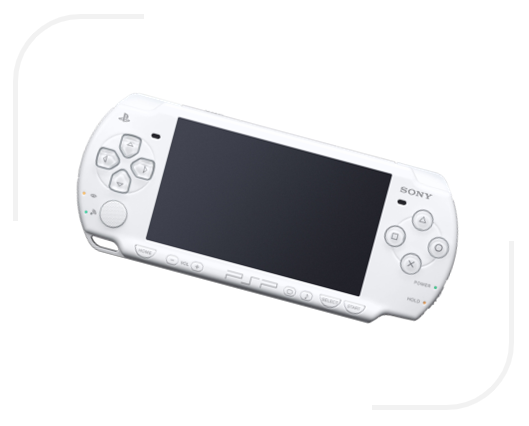
PlayStation | PSP
“Sony PlayStation | PSP”
Manufacturer.| Sony Electronics
Developer.| Sony Interactive Entertainment
Type. | Handheld Game Console
Generation.| Seventh (7th)
The PlayStation Portable( PSP) is a handheld game console developed and marketed by Sony Computer Entertainment. It was first released in Japan on December 12, 2004, in North America on March 24, 2005, and in PAL regions on September 1, 2005, and is the first handheld instalment in the PlayStation line of consoles. As a seventh generation console, the PSP competed with the Nintendo DS.
Development of the PSP was announced during E3 2003, and the console was unveiled at a Sony press conference on May 11, 2004. The system was the most powerful portable console when it was introduced, and was the first real competitor of Nintendo's handheld consoles after many challengers such as Nokia's N-Gage had failed. The PSP's advanced graphics capabilities made it a popular mobile entertainment device, which could connect to the PlayStation 2 and PlayStation 3, any computer with a USB interface, other PSP systems, and the Internet. The PSP also had a vast array of multimedia features such as video playback, audio playback, and has been considered a portable media player as well. The PSP is the only handheld console to use an optical disc format—in this case, Universal Media Disc (UMD)—as its primary storage medium; both games and movies have been released on the format.
The PSP was received positively by critics, and sold over 80 million units during its ten-year lifetime. Several models of the console were released, before the PSP line was succeeded by the PlayStation Vita, released in Japan in 2011 and worldwide a year later. The Vita has backward compatibility with PSP games that were released on the PlayStation Network through the PlayStation Store, which became the main method of purchasing PSP games after Sony shut down access to the store from the PSP on March 31, 2016. Hardware shipments of the PSP ended worldwide in 2014; production of UMDs ended when the last Japanese factory producing them closed in late 2016.
History
Sony Computer Entertainment first announced development of the PlayStation Portable at a press conference preceding E3 2003 Although samples were not presented, Sony released extensive technical details. CEO Ken Kutaragi called the device the "Walkman of the 21st century", a reference to the console's multimedia capabilities. Several gaming websites were impressed with the handheld's computing capabilities, and looked forward to its potential as a gaming platform.
In the 1990s, Nintendo had dominated the handheld market since launching its Game Boy in 1989, experiencing close competition only from Sega's Game Gear (1990–2001) and Bandai's WonderSwan (1999–2003) in Japan. In January 1999, Sony had released the briefly successful PocketStation in Japan as its first foray into the handheld gaming market. The SNK Neo Geo Pocket and Nokia's N-Gage also failed to cut into Nintendo's share. According to an IDC analyst in 2004, the PSP was the "first legitimate competitor to Nintendo's dominance in the handheld market".
The first concept images of the PSP appeared at a Sony corporate strategy meeting in November 2003, and featured a model with flat buttons and no analogue joystick. Although some reviewers expressed concern about the lack of an analogue stick, these fears were allayed when the PSP was officially unveiled at the Sony press conference during E3 2004. Sony released a list of 99 developer companies that pledged support for the new handheld. Several game demos such as Konami's Metal Gear Acid and Studio Liverpool's Wipeout Pure were also shown at the conference.
Launch
On October 17, 2004, Sony announced that the PSP base model would be launched in Japan on December 12 that year for ¥19,800 (about US$181 in 2004) while the Value System would launch for ¥24,800 (about US$226). The launch was a success, with over 200,000 units sold on the first day of sales. Colour variations were sold in bundle packs that cost around $200. On February 3, 2005, Sony announced that the PSP would be released in North America on March 24 in one configuration for an MSRP of US$249/CA$299. Some commentators expressed concern over the high price, which was almost US$20 higher than that of the Japanese model and over $100 higher than the Nintendo DS. Despite these concerns, the PSP's North American launch was a success; Sony said 500,000 units were sold in the first two days of sales, though it was also reported that this figure was below expectations.
The PSP was originally intended to have a simultaneous PAL and North American launch, but on March 15, 2005, Sony announced that the PAL launch would be delayed due to high demand for the console in Japan and North America. The next month, Sony announced that the PSP would be launched in the PAL region on September 1, 2005, for €249/£179. Sony defended the high price by saying North American consumers had to pay local sales taxes and that the Value Added Tax (sales tax) was higher in the UK than the US. Despite the high price, the PSP's PAL launch was a success, with the console selling over 185,000 units in the UK. All stock of the PSP in the UK sold out within three hours of its launch, more than doubling the previous first-day sales record of 87,000 units set by the Nintendo DS. The system also enjoyed great success in other areas of the PAL region; over 25,000 units were pre-ordered in Australia and nearly one million units were sold across Europe in the system's first week of sales.
Hardware

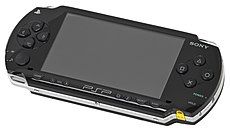
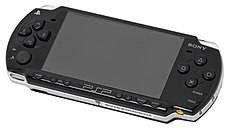
The PlayStation Portable uses the common "bar" form factor. The original model measures approximately 6.7 by 2.9 by 0.9 inches (170 by 74 by 23 mm) and weighs 9.9 ounces (280 g). The front of the console is dominated by the system's 4.3-inch (110 mm) LCD screen, which is capable of 480 × 272 pixel display resolution with 24-bit color, outperforming the Nintendo DS. Also on the unit's front are the four iconic PlayStation face buttons (  ,
,  ,
,  ,
,  ); the directional pad, the analog "nub", and several other buttons. The system also has two shoulder buttons, a USB 2.0 mini-B port on the top of the console, and a wireless LAN switch and power cable input on the bottom. The back of the PSP features a read-only Universal Media Disc (UMD) drive for access to movies and games, and a reader compatible with Sony's Memory Stick PRO Duo flash cards is located on the left of the system. Other features include an IrDA-compatible infrared port (this was discontinued in PSP-2000 and later) and a two-pin docking connector; built-in stereo speakers and headphone port; and IEEE 802.11b Wi-Fi for access to the Internet, free online multiplayer gaming via PlayStation Network, the ability to purchase games from PlayStation Store (now discontinued), and data transfer.
The PSP uses two 333 MHz MIPS32 R4000 R4k-based CPUs, as a main CPU and Media Engine, a GPU running at 166 MHz, and includes 32 MB main RAM (64 MB on PSP-2000 and later models), and 4 MB embedded DRAM split between the aforementioned GPU and Media Engine. The hardware was originally forced to run more slowly than it was capable of; most games ran at 222 MHz. With firmware update 3.50 on May 31, 2007, however, Sony removed this limit and allowed new games to run at 333 MHz.
The PSP is powered by an 1800 mAh battery (1200 mAh on the 2000 and 3000 models) that provides between about three and six hours of gameplay, between four and five hours of video playback, or between eight and eleven hours of audio playback.
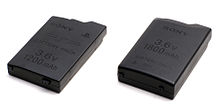
To make the unit slimmer, the capacity of the PSP's battery was reduced from 1800 mAh to 1200 mAh in the PSP-2000 and 3000 models. Due to more efficient power use, however, the expected playing time is the same as that of older models. The original high-capacity batteries work on the newer models, giving increased playing time, though the battery cover does not fit. The batteries take about 1.5 hours to charge and last for between four-and-a-half and seven hours depending on factors such as screen brightness settings, the use of WLAN, and volume levels. In March 2008, Sony released the Extended Life Battery Kit in Japan, which included a bulkier 2200 mAh battery with a fitting cover. In Japan, the kit was sold with a specific-colored cover matching the many PSP variations available. The North American kit released in December 2008 was supplied with two new covers; one black and one silver.
PSP-2000

The PSP-2000, marketed in PAL countries as the "PSP Slim", is the first redesign of the PlayStation Portable. The PSP-2000 system is slimmer and lighter than the original PSP, reduced from 0.91 to 0.73 inches (23 to 18.6 mm) and from 9.87 to 6.66 ounces (280 to 189 g). At E3 2007, Sony released information about a slimmer and lighter version for the device, which was first released in Hong Kong on August 30, 2007, in Europe on September 5 , in North America on September 6 , in South Korea on September 7 , and in Australia on September 12. The UK release for the PSP-2000 was September 14.
The serial port was modified to accommodate a new video-out feature, making it incompatible with older PSP remote controls. On the PSP-2000, games only output to external monitors and televisions in progressive scan mode. Non-game video outputs work in either progressive or interlaced mode. USB charging was introduced and the D-Pad was raised in response to complaints of poor performance and the responsiveness of the buttons was improved.
Other changes include improved WLAN modules and micro-controller, and a thinner, brighter LCD screen. To improve the poor loading times of UMD games on the original PSP, the internal memory (RAM and Flash ROM) was doubled from 32 MB to 64 MB, part of which now acting as a cache, also improving the web browser's performance.
PSP-3000
In comparison with the PSP-2000, the 3000, marketed in PAL areas as "PSP Slim & Lite" or "PSP Brite", has an improved LCD screen with an increased colour range, five times the contrast ratio, a halved pixel response time, new sub-pixel structure, and anti-reflective technology to reduce outdoor glare. The disc tray, logos, and buttons were all redesigned, and a microphone was added. Games could now be output in either component or composite video using the video-out cable. Some outlets called this model "a minor upgrade".
The PSP-3000 was released in North America on October 14, 2008, in Japan on October 16 , in Europe on October 17 , and in Australia on October 23. In its first four days on sale in Japan, the PSP-3000 sold over 141,270 units, according to Famitsu ; it sold 267,000 units during October.
On its release, a problem with interlacing when objects were in motion on the PSP-3000 screen was noticed. Sony announced this problem would not be fixed.
PSP Go (N1000)

The PSP Go (model PSP-N1000) was released on October 1, 2009, in North American and European territories, and on November 1 in Japan. It was revealed prior to E3 2009 through Sony's Qore video on demand service. Its design is significantly different from other PSP models.
The unit is 43% lighter and 56% smaller than the original PSP-1000, and 16% lighter and 35% smaller than the PSP-3000. Its rechargeable battery is not intended to be removed by the user. It has a 3.8-inch (97 mm) 480 × 272 pixel LCD screen, which slides up to reveal the main controls. The overall shape and sliding mechanism are similar to those of Sony's mylo COM-2 Internet device.
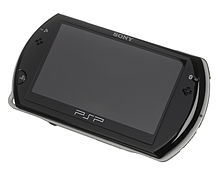
The PSP Go features 802.11b Wi-Fi like its predecessors, although the USB port was replaced with a proprietary connector. A compatible cable that connects to other devices' USB ports is included with the unit. The new multi-use connector allows video and sound output with the same connector using an optional composite or component AV cable. As with previous models, Sony also offers a cradle (PSP-N340) for charging, video out, and USB data transfer on the PSP Go. This model adds support for Bluetooth connectivity, which enables the playing of games using a Sixaxis or DualShock 3 controller. The use of the cradle with the controller allow players to use the PSP Go as a portable device and as a console, although the output is not upscaled. PlayStation 1 games can be played in full screen using the AV/component cable or the cradle.
The PSP Go lacks a UMD drive, and instead has 16 GB of internal flash memory, which can be extended by up to 32 GB with the use of a Memory Stick Micro (M2). Games must be downloaded from the PlayStation Store. The removal of the UMD drive effectively region-locks the unit because it must be linked to a single, region-locked PlayStation Network account. While the PSP Go can download games to itself, users can also download and transfer games to the device from a PlayStation 3 console, or the Windows-based software Media Go.
All downloadable PSP and PlayStation games available for older PSP models are compatible with the PSP Go. Sony confirmed that almost all UMD-based PSP games released after October 1, 2009, would be available to download and that most older UMD-only games would also be downloadable.
In February 2010, it was reported that Sony might re-launch the PSP Go due to the lack of consumer interest and poor sales. In June 2010, Sony began bundling the console with 10 free downloadable games; the same offer was made available in Australia in July. Three free games for the PSP Go were offered in America. In October that year, Sony announced it would reduce the price of the unit. On April 20, 2011, the manufacturer announced that the PSP Go would be discontinued outside of North America so it could concentrate on the PlayStation Vita.
PSP Street (E1000)

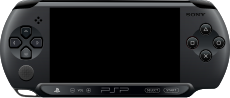
The PSP-E1000, which was announced at Gamescom 2011, is a budget-focused model that was released across the PAL region on October 26 of that year. The E1000 lacks Wi-Fi capability and has a matte finish similar to that of the slim PlayStation 3. It has a monaural speaker instead of the previous models' stereo speakers and lacks a microphone. This model also lacked the physical brightness buttons from the front of the handheld, instead offering brightness controls in the System Software's 'Power Save Settings' menu.
An ice-white version was released in PAL territories on July 20, 2012.
Bundles and colors
The PSP was sold in four main configurations. The Base Pack, called the Core Pack in North America, contained the console, a battery, and an AC adapter. This version was available at launch in Japan and was released later in North America and Europe.
Many limited editions of the PSP were bundled with accessories, games, or movies.
The first initial release of the Slims in North America on September 5, 2007, sold Daxter PSPs. Included with the bundle was an Ice Silver PSP with a Daxter UMD, the Family Guy : Freaking Sweet Collection, and a 1 GB Memory Stick for usage.
Limited-edition models were first released in Japan on September 12, 2007; North America and Europe on September 5; in Australia on September 12, and in the UK on October 26. The PSP-2000 was made available in piano black, ceramic white, ice silver, mint green, felicia blue, lavender purple, deep red, matte bronze, metallic blue, and rose pink as standard colours. Several special-edition consoles were coloured and finished to sell with certain games, including Final Fantasy VII: Crisis Core (ice silver engraved), Star Ocean: First Departure (felicia blue engraved), Gundam (red gloss/matte black), and Monster Hunter Freedom (gold silkscreened) in Japan, Star Wars (Darth Vader silkscreened), and God of War: Chains of Olympus (Kratos silkscreened) in North America, The Simpsons (bright yellow with white buttons, analogue and disc tray) in Australia and New Zealand, and Spider-Man (red gloss/matte black) in Europe.
The PSP-3000 was made available in piano black, pearl white, mystic silver, radiant red, vibrant blue, spirited green, blossom pink, turquoise green and lilac purple. The limited edition "Big Boss Pack" of Metal Gear Solid: Peace Walker had a camouflage pattern while the God of War: Ghost of Sparta bundle pack included a black-and-red two-toned PSP. The Dissidia 012 Final Fantasy Cosmos & Chaos edition that was released on March 3, 2011, has an Amano artwork as the PSP's face plate.
Comparison
Below is a comparison of the different PlayStation Portable models:




System software
While System Software updates can be used with consoles from any region, Sony recommends only downloading updates released for the model's region. System Software updates have added many features, including a web browser, Adobe Flash support, additional codecs for various media, PlayStation 3 (PS3) connectivity, and patches against security exploits and the execution of homebrew programs. The most recent version, numbered 6.61, was released on January 15, 2015.
Released Date.| 2004 Japan / 2005 Europe
Discontinued.| 2014 Worldwide
Worldwide Units Sold.| 82 Million
Predecessor.| Pocket Station
Successor.| PlayStation Vita