zZ
|
Shopping Plaza
making life a little lighter
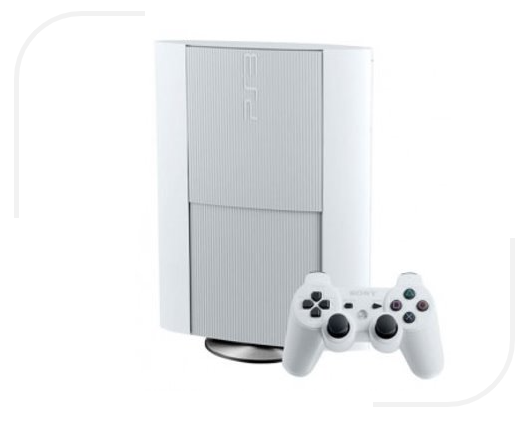
PlayStation | 3 Super Slim
“Sony PlayStation | 3 Super Slim”
Manufacturer.| Sony Electronics
Developer.| Sony Interactive Entertainment
Type. | Dedicated Console
Generation.| Seventh (7th)
The PlayStation 3( PS3) is a home video game console developed by Sony Interactive Entertainment. The successor to the PlayStation 2, it is part of the PlayStation brand of consoles. It was first released on November 11, 2006, in Japan, November 17, 2006, in North America, and March 23, 2007, in Europe and Australia. The PlayStation 3 competed primarily against Microsoft's Xbox 360 and Nintendo's Wii as part of the seventh generation of video game consoles.
The console was first officially announced at E3 2005, and was released at the end of 2006. It was the first console to use Blu-ray Disc technology as its primary storage medium. The console was the first PlayStation to integrate social gaming services, including the PlayStation Network, as well as the first to be controllable from a handheld console, through its remote connectivity with PlayStation Portable and PlayStation Vita. In September 2009, the Slim model of the PlayStation 3 was released. It no longer provided the hardware ability to run PS2 games. It was lighter and thinner than the original version, and featured a redesigned logo and marketing design, as well as a minor start-up change in software. A Super Slim variation was then released in late 2012, further refining and redesigning the console.
During its early years, the system received a mixed reception, due to its high price ($599 for a 60-gigabyte model, $499 for a 20 GB model), a complex processor architecture, and lack of quality games but was praised for its Blu-ray capabilities and "untapped potential". The reception would get more positive over time. The system had a slow start in the market but managed to recover, particularly after the introduction of the Slim model. Its successor, the PlayStation 4, was released later in November 2013. On September 29, 2015, Sony confirmed that sales of the PlayStation 3 were to be discontinued in New Zealand, but the system remained in production in other markets. Shipments of new units to Europe and Australia ended in March 2016, followed by North America which ended in October 2016. Heading into 2017, Japan was the last territory where new units were still being produced until May 29, 2017, when Sony confirmed the PlayStation 3 was discontinued in Japan.
History
The PlayStation 3 began development on March 9, 2001 when Ken Kutaragi, then the President of Sony Interactive Entertainment, announced that Sony, Toshiba, and IBM would collaborate on developing the Cell microprocessor. At the time, Shuhei Yoshida led a group of programmers within this hardware team to explore next-generation game creation. By early 2005, focus within Sony shifted towards developing PS3 launch titles. Sony officially unveiled PlayStation 3 to the public on May 16, 2005, at E3 2005, along with a boomerang-shaped prototype design of the Sixaxis controller. A functional version of the system was not present there, nor at the Tokyo Game Show in September 2005, although demonstrations (such as Metal Gear Solid 4: Guns of the Patriots ) were held at both events on software development kits and comparable personal computer hardware. Video footage based on the predicted PlayStation 3 specifications was also shown (notably a Final Fantasy VII tech demo).
The initial prototype shown in May 2005 featured two HDMI ports, three Ethernet ports and six USB ports; however, when the system was shown again a year later at E3 2006, these were reduced to one HDMI port, one Ethernet port and four USB ports, presumably to cut costs. Two hardware configurations were also announced for the console: a 20 GB model and a 60 GB model, priced at US$499 (€499) and US$599 (€599), respectively. The 60 GB model was to be the only configuration to feature an HDMI port, Wi-Fi internet, flash card readers and a chrome trim with the logo in silver. Both models were announced for a simultaneous worldwide release: November 11, 2006, for Japan and November 17, 2006, for North America and Europe.
On September 6, 2006, Sony announced that PAL region PlayStation 3 launch would be delayed until March 2007, because of a shortage of materials used in the Blu-ray drive. At the Tokyo Game Show on September 22, 2006, Sony announced that it would include an HDMI port on the 20 GB system, but a chrome trim, flash card readers, silver logo and Wi-Fi would not be included. Also, the launch price of the Japanese 20 GB model was reduced by over 20%, and the 60 GB model was announced for an open pricing scheme in Japan. During the event, Sony showed 27 playable PS3 games running on final hardware.
Launch

The PlayStation 3 was first released in Japan on November 11, 2006, at 07:00. According to Media Create, 81,639 PS3 systems were sold within 24 hours of its introduction in Japan. There were reports that many of the initial systems were obtained by businessmen who paid mainly Chinese nationals to buy the system without any software to resell on eBay, and, as a result of this, there were more hardware units sold than there were games. Ridge Racer 7 was the highest selling game on launch day. Soon after its release in Japan, the PS3 was released in North America on November 17, 2006. Reports of violence surrounded the release of the PS3. A customer was shot, campers were robbed at gunpoint, customers were shot in a drive-by shooting with BB guns, and 60 campers fought over 10 systems. The PS3 was released on the same day in Hong Kong and Taiwan as well.
The console was originally planned for a global release through November, but at the start of September the release in Europe and the rest of the world was delayed until March. Since it was a somewhat last-minute delay, some companies had taken deposits for pre-orders, at which Sony informed customers that they were eligible for full refunds or could continue the pre-order. On January 24, 2007, Sony announced that PlayStation 3 would go on sale on March 23, 2007, in Europe, Australia, the Middle East, Africa and New Zealand.
On March 7, 2007, the 60 GB PlayStation 3 launched in Singapore with a price of S$799. In the United Arab Emirates, the system retailed for 2499 dirhams on March 23, slightly less than the price in Europe. Sony also hosted a large launch party with singer Shakira performing at the Dubai Auto drome.
The PS3 sold 600,000 units in the first two days of its release in Europe. It became the fastest-selling home system in the United Kingdom with 165,000 units sold in two days, and became the second-fastest-selling system in the UK overall, the fastest being the PlayStation Portable. Some British retailers claim that the PS3 was subjected to as many as 20,000 pre-order cancellations, while others cited a "huge demand" for the system. System sales for the following week were down 82%, selling 30,000 units, with a 60% drop in sales of the two most popular titles, MotorStorm and Resistance: Fall of Man . Its UK launch price of £425 was higher than its Japanese and American prices, with value-added tax cited as a reason by a staff member. The continental Europe price was €599, while in Ireland it was €629.
Over 27,000 units were sold in Australia over the course of the first ten days of sales and nine of the top ten best-selling games, including systems and handheld, of the week were for the PS3; overall, software and hardware sales resulted in A$33 million netted for Sony. One analyst called it "a spike in retail spending not previously witnessed at the launch of any other system in Australia". In New Zealand, over 4,800 units were sold in the first week generating "over NZ$6.8 million dollars in hardware and software retail sales."
On April 27, 2007, it launched in India, with the 60 GB model retailing for ₹39,990 (US$1000 at the conversion rate at the time). In Mexico, the 20 GB model launched with a price of 10,495 pesos, or US$974 at the time. The console was launched in South Korea on June 16, 2007, as a single version equipped with an 80 GB hard drive and IPTV.
Slim model
Following speculation that Sony was working on a 'slim' model, Sony officially announced the PS3 CECH-2000 model on August 18, 2009, at the Sony Gamescom press conference. New features included a slimmer form factor, decreased power consumption, and a quieter cooling system. It was released in major territories by September 2009. At the same time, a new logo was introduced for the console to replace the previous " Spider-Man " wordmarks (named due to their use of the same font as the logos of Sony's then-current Spider-Man films), with a new "PS3" wordmark evoking the design of the PlayStation 2 wordmark replacing the capitalized PlayStation 3 lettering.
Super Slim model
In September 2012 at the Tokyo Game Show, Sony announced that a new, slimmer PS3 redesign (CECH-4000) was due for release in late 2012 and that it would be available with either a 250 GB or 500 GB hard drive. Three versions of the Super Slim model were revealed: one with a 500 GB hard drive, a second with a 250 GB hard drive which was not available in PAL regions, and a third with a 12 GB flash storage that was available in PAL regions, and in Canada. The storage of 12 GB model was upgradable with an official standalone 250 GB hard drive, and a vertical stand was also released for the model. In the United Kingdom, the 500 GB model was released on September 28, 2012; and the 12 GB model was released on October 12, 2012. In the United States, the PS3 Super Slim was first released as a bundled console. The 250 GB model was bundled with the Game of the Year edition of Uncharted 3: Drake's Deception and released on September 25, 2012; and the 500 GB model was bundled with Assassin's Creed III and released on October 30, 2012. In Japan, the black coloured Super Slim model was released on October 4, 2012; and the white coloured Super Slim model was released on November 22, 2012. The Super Slim model is 20 percent smaller and 25 percent lighter than the Slim model and features a manual sliding disc cover instead of a motorized slot-loading disc cover of the Slim model. The white coloured Super Slim model was released in the United States on January 27, 2013, as part of the Instant Game Collection Bundle . The Garnet Red and Azurite Blue coloured models were launched in Japan on February 28, 2013. The Garnet Red version was released in North America on March 12, 2013, as part of the God of War: Ascension bundle with 500 GB storage and contained God of War: Ascension as well as the God of War Saga . The Azurite Blue model was released on October 8, 2013, as a GameStop exclusive with 250 GB storage.
Games
At E3 2007, Sony was able to show a number of their upcoming video games for PlayStation 3, including Heavenly Sword , Lair , Ratchet & Clank Future: Tools of Destruction , Warhawk and Uncharted: Drake's Fortune ; all of which were released in the third and fourth quarters of 2007. It also showed off a number of titles that were set for release in 2008 and 2009; most notably Killzone 2 , Infamous , Gran Turismo 5 Prologue , LittleBigPlanet and SOCOM U.S. Navy SEALs: Confrontation. A number of third-party exclusives were also shown, including the highly anticipated Metal Gear Solid 4: Guns of the Patriots , alongside other high-profile third-party titles such as Grand Theft Auto IV , Call of Duty 4: Modern Warfare , Assassin's Creed , Devil May Cry 4 and Resident Evil 5 . Two other important titles for PlayStation 3, Final Fantasy XIII and Final Fantasy Versus XIII , were shown at TGS 2007 in order to appease the Japanese market.
Sony have since launched their budget range of PlayStation 3 titles, known as the Greatest Hits range in North America, the Platinum range in Europe and Australia and The Best range in Japan. Among the titles available in the budget range include Resistance: Fall of Man , MotorStorm , Uncharted: Drake's Fortune , Rainbow Six: Vegas , Call of Duty 3 , Assassin's Creed and Ninja Gaiden Sigma . As of October 2009 Metal Gear Solid 4: Guns of the Patriots , Ratchet & Clank Future: Tools of Destruction , Devil May Cry 4 , Army of Two , Battlefield: Bad Company and Midnight Club: Los Angeles have also joined the list.
As of March 31, 2012, there have been 595 million games sold for PlayStation 3. The best selling PS3 games are Grand Theft Auto V , Gran Turismo 5 , The Last of Us , Uncharted 3: Drake's Deception and Uncharted 2: Among Thieves .
The last game released on the PlayStation 3 was Shakedown: Hawaii , on August 20, 2020.
Stereoscopic 3D
In December 2008, the CTO of Blitz Games announced that it would bring stereoscopic 3D gaming and movie viewing to Xbox 360 and PlayStation 3 with its own technology. This was first demonstrated publicly on PS3 using Sony's own technology in January 2009 at the Consumer Electronics Show. Journalists were shown Wipeout HD and Gran Turismo 5 Prologue in 3D as a demonstration of how the technology might work if it is implemented in the future. Firmware update 3.30 officially allowed PS3 titles to be played in 3D, requiring a compatible display for use. System software update 3.50 prepared it for 3D films. While the game itself must be programmed to take advantage of the 3D technology, titles may be patched to add in the functionality retroactively. Titles with such patches include Wipeout HD , Pain , and Super Stardust HD .
Hardware

PlayStation 3 is convex on its left side, with the PlayStation logo upright, when vertical (the top side is convex when horizontal) and has a glossy black finish. PlayStation designer Teiyu Goto stated that the Spider-Man -font-inspired logo "was one of the first elements SCEI president Ken Kutaragi decided on and the logo may have been the motivating force behind the shape of PS3".
Technical specifications
PlayStation 3 features a slot-loading 2× speed Blu-ray Disc drive for games, Blu-ray movies, DVDs, and CDs. It was originally available with hard drives of 20 and 60 GB (20 GB model was not available in PAL regions) but various sizes up to 500 GB have been made available since then (see: model comparison). All PS3 models have user-upgradeable 2.5" SATA hard drives.
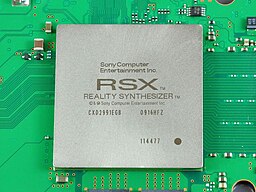
PlayStation 3 uses the Cell microprocessor, designed by Sony, Toshiba and IBM, as its CPU, which is made up of one 3.2 GHz PowerPC-based "Power Processing Element" (PPE) and eight Synergistic Processing Elements (SPEs). To increase yields and reduce costs, the chip has 8 SPEs. After manufacture, every chip is tested and a defective SPE disconnected using laser trimming, leaving 7 SPEs. This means that otherwise discarded processors can be used, reducing costs and waste. Only six of the seven SPEs are accessible to developers as the seventh SPE is reserved by the console's operating system, Graphics processing is handled by the Nvidia RSX 'Reality Synthesizer', which can produce resolutions from 480i/576i SD up to 1080p HD. PlayStation 3 has 256 MB of XDR DRAM main memory and 256 MB of GDDR3 video memory for the RSX. Originally, Sony did not plan to include any GPU in the PlayStation 3, because they thought that the Cell could handle everything, but the developers, including the ICE team from Naughty Dog, demonstrated to Sony that without a dedicated GPU, the PlayStation 3 performance would not be sufficient, particularly in comparison to the Xbox 360. Sony henced added a GPU, the Nvidia RSX, at the final stage of the PlayStation 3 development.
The system has Bluetooth 2.0 (with support for up to seven Bluetooth devices), Gigabit Ethernet, USB 2.0 and HDMI 1.4 built in. Wi-Fi networking is also built-in on all but the 20 GB models, while a flash card reader (compatible with Memory Stick, SD/MMC and CompactFlash/Microdrive media) is built-in on 60 GB and CECHExx 80 GB models.
Models
Controllers and accessories

Numerous accessories for the console have been developed. These accessories include the wireless Sixaxis and DualShock 3 controllers, the Logitech Driving Force GT, the Logitech Cordless Precision Controller, the BD Remote, the PlayStation Eye camera, and the PlayTV DVB-T tuner/digital video recorder accessory.
At Sony's E3 press conference in 2006, the then-standard wireless Sixaxis controller was announced. The controller was based on the same basic design as the PlayStation 2's DualShock 2 controller but was wireless, lacked vibration capabilities, had a built-in accelerometer (that could detect motion in three directional and three rotational axes; six in total, hence the name Sixaxis) and had a few cosmetic tweaks.
At its press conference at the 2007 Tokyo Game Show, Sony announced DualShock 3 (trademarked DUALSHOCK 3), a PlayStation 3 controller with the same function and design as Sixaxis, but with vibration capability included. Hands-on accounts describe the controller as being noticeably heavier than the standard Sixaxis controller and capable of vibration forces comparable to DualShock 2. It was released in Japan on November 11, 2007; in North America on April 5, 2008; in Australia on April 24, 2008; in New Zealand on May 9, 2008; in mainland Europe on July 2, 2008, and in the United Kingdom and Ireland on July 4, 2008.
During E3 2009, Sony unveiled plans to release a motion controller later to be named PlayStation Move at GDC 2010. It was released on September 15, 2010, in Europe; September 19, 2010, in North America and October 21, 2010, in Japan.
On October 13, 2010, Sony announced an official surround sound system for PS3 through the official PlayStation YouTube channel.
The PlayStation 3 can also use DualShock 4 controller initially via USB cable, but Firmware update 4.60 enabled wireless connection.
System software
Sony has included the ability for the operating system, referred to as System Software , to be updated. The updates can be acquired in several ways:
- If PlayStation 3 has an active Internet connection, updates may be downloaded directly from the PlayStation Network to PlayStation 3 and subsequently installed. Systems with active Internet will automatically check online for software updates each time the console is started.
- Using an external PC, a user may download the update from the official PlayStation website, transfer it to portable storage media and install it on the system.
- Some game discs come with system software updates on the disc. This may be due to the game requiring an update in order to run. If so, the software may be installed from the disc.
The original PlayStation 3 also included the ability to install other operating systems, such as Linux. This was not included in the newer slim models and was removed from all older PlayStation 3 consoles with the release of firmware update 3.21 in April 2010. The functionality is now only available to users of original consoles who choose not to update their system software beyond version 3.15 or who have installed third-party, modified and unofficial versions of the firmware instead.
Graphical user interface

The standard PlayStation 3 version of the XrossMediaBar (pronounced "Cross Media Bar" and abbreviated XMB) includes nine categories of options. These are: Users , Settings , Photo , Music , Video , TV/Video Services , Game , Network , PlayStation Network and Friends (similar to the PlayStation Portable media bar). The TV/Video Services category is for services like Netflix and/or if PlayTV or torne is installed; the first category in this section is "My Channels", which lets users download various streaming services, including Sony's own streaming services Crackle and PlayStation Vue. By default, the What's New section of PlayStation Network is displayed when the system starts up. PS3 includes the ability to store various master and secondary user profiles, manage and explore photos with or without a musical slide show, play music and copy audio CD tracks to an attached data storage device, play movies and video files from the hard disk drive, an optical disc (Blu-ray Disc or DVD-Video) or an optional USB mass storage or Flash card, compatibility for a USB keyboard and mouse and a web browser supporting compatible-file download function. Additionally, UPnP media will appear in the respective audio/video/photo categories if a compatible media server or DLNA server is detected on the local network. The Friends menu allows mail with emoticon and attached picture features and video chat which requires an optional PlayStation Eye or EyeToy webcam. The Network menu allows online shopping through the PlayStation Store and connectivity to PlayStation Portable via Remote Play.
Digital rights management
PlayStation 3 console protects certain types of data and uses digital rights management to limit the data's use. Purchased games and content from the PlayStation Network store are governed by PlayStation's Network Digital Rights Management (NDRM). The NDRM allows users to access the data from up to 2 different PlayStation 3's that have been activated using a user's PlayStation Network ID. PlayStation 3 also limits the transfer of copy protected videos downloaded from its store to other machines and states that copy protected video "may not restore correctly" following certain actions after making a backup such as downloading a new copy protected movie.
Photo management
- Photo Gallery

Photo Gallery is an optional application to view, create, and group photos from PS3, which is installed separately from the system software at 105 MB. It was introduced in system software version 2.60 and provides a range of tools for sorting through and displaying the system's pictures. The key feature of this application is that it can organize photos into groups according to various criteria. Notable categorizations are colours, ages, or facial expressions of the people in the photos. Slideshows can be viewed with the application, along with music and playlists. The software was updated with the release of system software version 3.40 allowing users to upload and browse photos on Facebook and Picasa.
- PlayMemories Studio
PlayMemories is an optional stereoscopic 3D (and also standard) photo viewing application, which is installed from the PlayStation Store at 956 MB. The application is dedicated specifically to 3D photos and features the ability to zoom into 3D environments and change the angle and perspective of panoramas. It requires system software 3.40 or higher; 3D photos; a 3D HDTV, and an HDMI cable for the 3D images to be viewed properly.
Video services
- Video editor and uploader
A new application was released as part of system software version 3.40 which allows users to edit videos on PlayStation 3 and upload them to the Internet. The software features basic video editing tools including the ability to cut videos and add music and captions. Videos can then be rendered and uploaded to video sharing websites such as Facebook and YouTube.
- Video on demand
In addition to the video service provided by the Sony Entertainment Network, the PlayStation 3 console has access to a variety of third-party video services, dependent on the region:
Since June 2009, VidZone has offered a free music video streaming service in Europe, Australia and New Zealand. In October 2009, Sony Computer Entertainment and Netflix announced that the Netflix streaming service would also be available on PlayStation 3 in the United States. A paid Netflix subscription was required for the service. The service became available in November 2009. Initially users had to use a free Blu-ray disc to access the service; however, in October 2010 the requirement to use a disc to gain access was removed.
In April 2010, support for MLB.tv was added, allowing MLB.tv subscribers to watch regular season games live in HD and access new interactive features designed exclusively for PSN.
In November 2010, access to the video and social networking site MUBI was enabled for European, New Zealand, and Australian users; the service integrates elements of social networking with rental or subscription video streaming, allowing users to watch and discuss films with other users. Also in November 2010 the video rental service VUDU, NHL GameCenter Live, and subscription service Hulu Plus launched on PlayStation 3 in the United States.
In August 2011, Sony, in partnership with DirecTV, added NFL Sunday Ticket. Then in October 2011, Best Buy launched an app for its CinemaNow service. In April 2012, Amazon.com launched an Amazon Video app, accessible to Amazon Prime subscribers (in the US).
Upon reviewing the PlayStation and Netflix collaboration, Pocket-Lint said "We've used the Netflix app on Xbox too and, as good as it is, we think the PS3 version might have the edge here." and stated that having Netflix and LoveFilm on PlayStation is "mind-blowingly good."
In July 2013, YuppTV OTT player launched its branded application on the PS3 computer entertainment system in the United States.
Audio capabilities
The PlayStation 3 has the ability to play standard audio CDs, a feature that was notably removed from its successors. PlayStation 3 added the ability for ripping audio CDs to store them on the system's hard disk; the system has transcoders for ripping to either MP3, AAC, or Sony's own ATRAC (ATRAC3plus) formats. Early models were also able to playback Super Audio CDs, however this support was dropped in the third generation revision of the console from late 2007. However, all models do retain Direct Stream Digital playback ability.
PlayStation 3 can also play music from portable players by connecting the player to the system's USB port, including from Walkman digital audio players and other ATRAC players and other players that use the UMS protocol. The PlayStation 3 did not feature the Sony CONNECT Music Store.
OtherOS support
The 'OtherOS' functionality was not present in the updated PS Slim models, and the feature was subsequently removed from previous versions of the PS3 as part of the machine's firmware update version 3.21 which was released on April 1, 2010; Sony cited security concerns as the rationale. The firmware update 3.21 was mandatory for access to the PlayStation Network. The removal caused some controversy; as the update removed officially advertised features from already sold products, and gave rise to several class action lawsuits aimed at making Sony return the feature or provide compensation.
On December 8, 2011, U.S. District Judge Richard Seeborg dismissed the last remaining count of the class action lawsuit (other claims in the suit had previously been dismissed), stating: "As a legal matter, . plaintiffs have failed to allege facts or articulate a theory on which Sony may be held liable."
As of January 2014, the U.S. Court of Appeals for the Ninth Circuit partially reversed the dismissal and have sent the case back to the district court.
Leap year bug
On March 1, 2010 (UTC), many of the original PlayStation 3 models worldwide were experiencing errors related to their internal system clock. The error had many symptoms. Initially, the main problem seemed to be the inability to connect to the PlayStation Network. However, the root cause of the problem was unrelated to the PlayStation Network, since even users who had never been online also had problems playing installed offline games (which queried the system timer as part of start-up) and using system themes. At the same time, many users noted that the console's clock had gone back to December 31, 1999. The event was nicknamed the ApocalyPS3, a play on the word apocalypse and PS3, the abbreviation for the PlayStation 3 console.
The error code displayed was typically 8001050F and affected users were unable to sign in, play games, use dynamic themes, and view/sync trophies. The problem only resided within the first- through third-generation original PS3 units while the newer "Slim" models were unaffected because of different internal hardware for the clock.
Sony confirmed that there was an error and stated that it was narrowing down the issue and were continuing to work to restore service. By March 2 (UTC), 2010, owners of original PS3 models could connect to PSN successfully and the clock no longer showed December 31, 1999. Sony stated that the affected models incorrectly identified 2010 as a leap year, because of a bug in the BCD method of storing the date. However, for some users, the hardware's operating system clock (mainly updated from the internet and not associated with the internal clock) needed to be updated manually or by re-syncing it via the internet.
On June 29, 2010, Sony released PS3 system software update 3.40, which improved the functionality of the internal clock to properly account for leap years.
PlayStation Portable connectivity
Sony has also demonstrated PSP playing back video content from PlayStation 3 hard disk across an ad hoc wireless network. This feature is referred to as Remote Play located under the browser icon on both PlayStation 3 and PlayStation Portable. Remote play has since expanded to allow remote access to PS3 via PSP from any wireless access point in the world.
PlayStation Network
PlayStation Plus
PlayStation Store
The PlayStation Store is updated with new content each Tuesday in North America, and each Wednesday in PAL regions. In May 2010 this was changed from Thursdays to allow PSP games to be released digitally, closer to the time they are released on UMD.
On March 29, 2021, Sony announced that it would shut down the PS3 version of the Store on July 2, though previous purchases on the store will remain downloadable. However, on April 19, following fan feedback, Sony reversed their decision and confirmed that the PS3 store would remain operational.
What's New
What's New was announced at Gamescom 2009 and was released on September 1, 2009, with PlayStation 3 system software 3.0. The feature was to replace the existing [Information Board], which displayed news from the PlayStation website associated with the user's region. The concept was developed further into a major PlayStation Network feature, which interacts with the [Status Indicator] to display a ticker of all content, excluding recently played content (currently in North America and Japan only).
The system displays the What's New screen by default instead of the [Games] menu (or [Video] menu, if a movie was inserted) when starting up. What's New has four sections: "Our Pick", "Recently Played", the latest information, and new content available in PlayStation Store. There are four kinds of content the What's New screen displays and links to, on the sections. "Recently Played" displays the user's recently played games and online services only, whereas, the other sections can contain website links, links to play videos, and access to selected sections of the PlayStation Store.
The PlayStation Store icons in the [Game] and [Video] section act similarly to the What's New screen, except that they only display and link to games and videos in the PlayStation Store, respectively.
PlayStation Home
A closed beta began in Europe from May 2007 and expanded to other territories soon after. Home was delayed and expanded several times before initially releasing. The Open Beta test was started on December 11, 2008. It remained as a perpetual beta until its closure on March 31, 2015. Home was available directly from the PlayStation 3 XrossMediaBar. Membership was free, but required a PSN account.
Home featured places to meet and interact, dedicated game spaces, developer spaces, company spaces, and events. The service underwent a weekly maintenance and frequent updates. At the time of its closure in March 2015, Home had been downloaded by over 41 million users.
Life with PlayStation
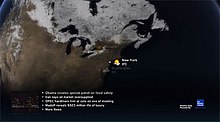
Life with PlayStation, released on September 18, 2008 to succeed Folding@home, was retired November 6, 2012. Life with PlayStation used virtual globe data to display news and information by city. Along with Folding@home functionality, the application provided access to three other information "channels", the first being the Live Channel offering news headlines and weather which were provided by Google News, The Weather Channel, the University of Wisconsin–Madison Space Science and Engineering Center, among other sources. The second channel was the World Heritage channel which offered historical information about historical sites. The third channel was the United Village channel. United Village was designed to share information about communities and cultures worldwide. An update allowed video and photo viewing in the application. The fourth channel was the U.S. exclusive PlayStation Network Game Trailers Channel for direct streaming of game trailers.
Outage
Critical reception
Early PlayStation 3 reviews after launch were critical of its high price and lack of quality games. Game developers regarded the architecture as difficult to program for. PS3 was, however, commended for its hardware including its Blu-ray home theatre capabilities and graphics potential.
Critical and commercial reception to PS3 improved over time, after a series of price revisions, Blu-ray's victory over HD DVD, and the release of several well received titles. Ars Technica ' s original launch review gave PS3 only a 6/10, but second review of the console in June 2008 rated it a 9/10. In September 2009, IGN named PlayStation 3 the 15th-best gaming console of all time, behind both of its competitors: Wii (10th) and Xbox 360 (6th). However, PS3 has won IGN's "Console Showdown"—based on which console offers the best selection of games released during each year—in three of the four years since it began (2008, 2009 and 2011, with Xbox winning in 2010). IGN judged PlayStation 3 to have the best game line-up of 2008, based on their review scores in comparison to those of Wii and Xbox 360. In a comparison piece by PC Magazine ' s Will Greenwald in June 2012, PS3 was selected as an overall better console compared to Xbox 360. Pocket-Lint said of the console "The PS3 has always been a brilliant games console," and that "For now, this is just about the best media device for the money."
Super Slim model
The Super Slim model of PS3 has received positive reviews. Gaming website Spong praised the new Super Slim's quietness, stating "The most noticeable noise comes when the drive seeks a new area of the disc, such as when starting to load a game, and this occurs infrequently." They added that the fans are quieter than those of Slim, and went on to praise the new smaller, lighter size. Criticism was placed on the new disc loader, stating: "The cover can be moved by hand if you wish, there's also an eject button to do the work for you, but there is no software eject from the triangle button menus in the Xross Media Bar (XMB) interface. In addition, you have to close the cover by hand, which can be a bit fiddly if it's upright, and the PS3 won't start reading a disc unless you do [close the cover]." They also said there is no real drop in retail price.
Tech media website CNET gave new Super Slim 4 out of 5 stars ("Excellent"), saying "The Super Slim PlayStation 3 shrinks a powerful gaming machine into an even tinier package while maintaining the same features as its predecessors: a great gaming library and a strong array of streaming services [...]", whilst also criticising the "cheap" design and disc-loader, stating: "Sometimes [the cover] doesn't catch and you feel like you're using one of those old credit card imprinter machines. In short, it feels cheap. You don't realize how convenient autoloading disc trays are until they're gone. Whether it was to cut costs or save space, this move is ultimately a step back." The criticism also was due to price, stating the cheapest Super Slim model was still more expensive than the cheapest Slim model, and that the smaller size and bigger hard drive shouldn't be considered an upgrade when the hard drive on a Slim model is easily removed and replaced. They did praise that the hard drive of the Super Slim model is "the easiest yet. Simply sliding off the side panel reveals the drive bay, which can quickly be unscrewed." They also stated that whilst the Super Slim model is not in any way an upgrade, it could be an indicator as to what's to come. "It may not be revolutionary, but the Super Slim PS3 is the same impressive machine in a much smaller package. There doesn't seem to be any reason for existing PS3 owners to upgrade, but for the prospective PS3 buyer, the Super Slim is probably the way to go if you can deal with not having a slot-loading disc drive."
Pocket-Lint gave Super Slim a very positive review saying "It's much more affordable, brilliant gaming, second-to-none video and media player." They think it is "A blinding good console and one that will serve you for years to come with second-hand games and even new releases. Without doubt, if you don't have a PS3, this is the time to buy." They gave Super Slim 4-and-a-half stars out of 5.
Technology magazine T3 gave the Super Slim model a positive review, stating the console is almost "nostalgic" in the design similarities to the original "fat" model, "While we don't know whether it will play PS3 games or Blu-ray discs any differently yet, the look and feel of the new PS3 Slim is an obvious homage to the original PS3, minus the considerable excess weight. Immediately we would be concerned about the durability of the top loading tray that feels like it could be yanked straight out off the console, but ultimately it all feels like Sony's nostalgic way of signing off the current-generation console in anticipation for the PS4.
DualShock 3

|
|

DualShock 3 controller
|
|
| Input |
|
|---|---|
| Connectivity | USB, Bluetooth (PS3 and PSP Go) |
| Power | Lithium-ion battery (3.7 V 300 mA or 5.0 V 500 mA, USB host powered |
| Dimensions | 160 mm × 97 mm × 55 mm (6.30 in × 3.82 in × 2.17 in) |
| Mass | 192 g (6.77 oz) |
| Predecessor | Sixaxis, DualShock 2 |
| Successor | DualShock 4 |


Announced at the 2007 Tokyo Game Show, the DualShock 3 wireless controller (SCPH-98050/CECHZC2) is a gamepad for the PlayStation 3. It replaces the Sixaxis wireless controller originally released with earlier versions of the console. The DualShock 3 is nearly identical to the previous Sixaxis version but adds the haptic feedback capabilities found in the DualShock and DualShock 2. Sony settled a patent infringement lawsuit with Immersion in March 2007 following a lengthy legal battle. The settlement cleared the way for incorporating the missing "rumble" feature that the Sixaxis lacked. Both the vibration function and motion-sensing capabilities of the DualShock 3 can be used simultaneously without one interfering with the other. Like the Sixaxis, it also has a USB mini-B port for charging and can also be used on a PSP Go via Bluetooth, though the controller and the PSP Go must be registered using a PS3 console.
The DualShock 3 can be identified by its "DualShock 3" and "Sixaxis" markings. It also weighs 192 grams (6.8 oz), 40% more than its predecessor, the Sixaxis, which weighed only 137.1 grams (4.84 oz).
The rear markings indicate the original DualShock 3 draws up to 300 mA of current at 3.7 V for a power consumption of 1.11 W, an order of magnitude increase from the 30 mA of current at 3.7 V (0.111 W) listed on the Sixaxis. However, this current is not drawn constantly and is the maximum current when the rumble is active. Its main power source is an internal 3.7 V Li-ion battery tentatively capable of storing 570 mAh, which provides up to 30 hours of continuous gaming on a full charge. Third party replacement batteries are also available. Like the Sixaxis, the DualShock 3 comes with instructions on how to remove and replace the battery. The DualShock 3 can also draw power over a USB cable via a USB mini-B connector on the top of the controller. This allows the controller to be used when the battery is low and is also used for charging the battery. When connected via USB, the controller communicates with the console through the USB cable, rather than Bluetooth.
Along with the release of the 'slim' model PS3, Sony released a new version of the DualShock 3 (A1) which uses 5.0 V at 500 mA while connected, but still contains a 3.7 V battery. This revision of the DualShock 3 does away with the additional plastic brackets between the L1/R1 buttons and the L2/R2 triggers (increasing controller rigidity), has indicator lights soldered directly to the board, and comes in slightly revised colour schemes.
While the DualShock 3 is compatible with any standard USB mini-B cable and many USB chargers, official charging cables are available from Sony. These include an official cable, the USB 2.0 Cable Pack and a wall charger, the AC adapter charging kit. Any third-party USB charger used must act as a USB host device, rather than simply providing power over the appropriate pins, since both the Sixaxis and DualShock 3 require a host signal to "wake up" and begin charging.
A Sony representative confirmed on April 2, 2008, that the original Sixaxis controller would officially be discontinued with the release of the haptic-feedback enabled DualShock 3 in mid-April 2008. The Sixaxis was no longer produced after 2008, being dropped from stock by most retailers.
Variations
The DualShock 3 has been produced in various colours: black, satin silver, ceramic white, classic white, metallic blue, deep red, pink, "jungle green" (olive),"candy blue" (light blue), "urban camouflage" (three-color digital camouflage), "crimson red" (transparent red), and "cosmic blue" (transparent blue). Not all colours have been made available in all markets or at all times.
Additional colours have also been made available alongside limited edition consoles, including gun-metal grey and "cloud black" (dark grey).
A limited edition baseball themed DualShock 3 controller was released on March 8, 2011 to coincide with the release of MLB 11: The Show . Another colour, "Metallic Gold", became available in June 2012 as a limited edition in Europe, while in North America it is sold exclusively in GameStop from October 2012. A limited edition God of War: Ascension controller is available in the UK as part of a console bundle to coincide with the launch of the game and in the Americas as a game and controller bundle. On November 1, 2013 Sony announced a new see-through "Crystal" model of the DualShock 3 controller in Japan.


Released Date.| 2012 Worldwide
Discontinued.| 2017 Japan / 2016 Europe
Worldwide Units Sold.| 87.4 Million
Predecessor.| PlayStation 2
Successor.| PlayStation 4 (PS4)