zZ
|
Shopping Plaza
making life a little lighter
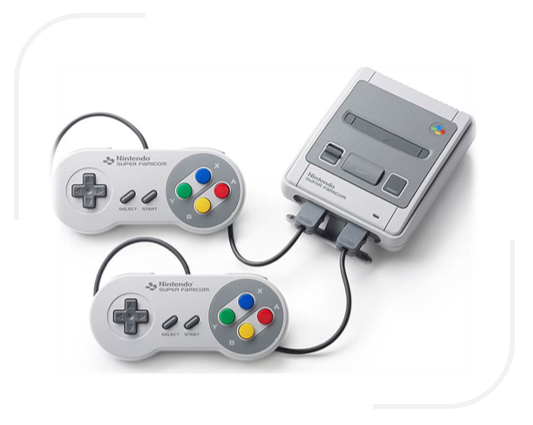
Nintendo | Mini SNES
“Nintendo | Mini Super Nintendo Entertainment System (SNES)”
Manufacturer.| Nintendo
Type. | Home Video Game Console
Generation.| Third (3rd)

Game cartridge
Super NES games are distributed on ROM cartridges, officially referred to as Game Pak in most Western regions, and as Cassette (カセット, Kasetto ) in Japan and parts of Latin America. Though the Super NES can address 128 Mbit, only 117.75 Mbit are actually available for cartridge use. A fairly normal mapping could easily address up to 95 Mbit of ROM data (48 Mbit at FastROM speed) with 8 Mbit of battery-backed RAM. Most available memory access controllers only support mappings of up to 32 Mbit. The largest games released ( Tales of Phantasia and Star Ocean ) contain 48 Mbit of ROM data and the smallest games contain only 2 Mbit.
Cartridges may also contain battery-backed SRAM to save the game state, extra working RAM, custom coprocessors, or any other hardware that will not exceed the maximum current rating of the console.
Peripherals

The Super NES controller design expands on that of the NES, with A, B, X, and Y face buttons in a diamond arrangement, and two shoulder buttons. Lance Barr created its ergonomic design, and he later adapted it in 1993 for the NES-039 "dogbone" controller. The Japanese and PAL region versions incorporate the four colours of the face buttons into the system's logo. The North American version's buttons are coloured to match the redesigned console; the X and Y buttons are lavender with concave faces, and the A and B buttons are purple with convex faces. Several later controller designs have elements from the Super NES controller, including the PlayStation, Dreamcast, Xbox, and Wii Classic Controller. This face button layout is on future Nintendo systems since the Nintendo DS.
Several peripherals add to the functionality of the Super NES. Some are required by certain games, such as the Super Scope light gun, and the Super NES Mouse for a point and click interface. Various third-parties, under license from Nintendo, released multitap adapters connecting up to five controllers into a single console, starting with the Super Multitap by Hudson Soft in conjunction with the Super Bomberman series. Specialized third-party controllers, such as the AsciiPad and Super Advantage (the successor to the NES Advantage) by Asciiware, and the Capcom Fighter Power Stick, an arcade-like joystick controller by Capcom designed specifically for Street Fighter II . Unusual controllers include the BatterUP baseball bat, the Life Fitness Entertainment System (an exercise bike controller with built-in monitoring software), the TeeV Golf golf club, and the Justifier (a revolver-shaped light gun made by Konami for Lethal Enforcers ).

Though Nintendo never released an adapter for playing NES games on the Super NES, the Super Game Boy adapter cartridge allows games designed for Nintendo's portable Game Boy system to be played on the Super NES. The Super Game Boy touts several feature enhancements over the Game Boy, including palette substitution, custom screen borders, and access to the Super NES console's features by specially enhanced Game Boy games. Japan also saw the release of the Super Game Boy 2, which adds a communication port to enable a second Game Boy to connect for multiplayer games.
Like the NES before it, the Super NES has unlicensed third-party peripherals, including a new version of the Game Genie cheat cartridge designed for use with Super NES games.
Soon after the release of the Super NES, companies began marketing backup devices such as the Super Wildcard, Super Pro Fighter Q, and Game Doctor. These devices create a backup of a cartridge, and can be used to play illicit ROM images or to copy games, violating copyright laws in many jurisdictions.

The Japan-only Satellaview is a satellite modem attached to the Super Famicom's expansion port and connected to the St.GIGA satellite radio station from April 23, 1995, to June 30, 2000. Satellaview subscribers could download gaming news and specially designed games, which were frequently either remakes of or sequels to older Famicom games, and released in installments. In the United States, the relatively short-lived XBAND allowed users to connect to a network via a dial-up modem to compete against other players around the country.
Nintendo attempted partnerships with Sony and then Philips, to develop CD-ROM-based peripheral prototypes for the console to compete with the Sega CD. Sony produced a Nintendo Play Station prototype which was cancelled, diverting this inertia into its own PlayStation console. The Philips project was cancelled without a prototype but Philips retained the contractual right to develop games based on Nintendo franchises, which it published for its CD-i multimedia console.
Enhancement chips

As part of the overall plan for the Super NES, rather than include an expensive CPU that would still become obsolete in a few years, the hardware designers made it easy to interface special coprocessor chips to the console, just like the MMC chips used for most NES games. This is most often characterized by 16 additional pins on the cartridge card edge.
The Super FX is a RISC CPU designed to perform functions that the main CPU can not feasibly do. The chip is primarily used to create 3D game worlds made with polygons, texture mapping and light source shading. The chip can also be used to enhance 2D games.
The Nintendo fixed-point digital signal processor (DSP) chip allowed for fast vector-based calculations, bitmap conversions, both 2D and 3D coordinate transformations, and other functions. Four revisions of the chip exist, each physically identical but with different microcode. The DSP-1 version, including the later 1A and 1B bug fix revisions, is used most often; the DSP-2, DSP-3, and DSP-4 are used in only one game each.
Similar to the 5A22 CPU in the console, the SA-1 chip contains a 65C816 processor core clocked at 10 MHz, a memory mapper, DMA, decompression and bitplane conversion circuitry, several programmable timers, and CIC region lockout functionality.
In Japan, games could be downloaded cheaper than standard cartridges, from Nintendo Power kiosks onto special cartridges containing flash memory and a MegaChips MX15001TFC chip. The chip manages communication with the kiosks to download ROM images and has an initial menu to select a game. Some were published both in cartridge and download form, and others were download only. The service closed on February 8, 2007.
Many cartridges contain other enhancement chips, most of which were created for use by a single company in a few games.
Reception and legacy

Approximately 49.1 million Super NES consoles were sold worldwide, with 23.35 million of those units sold in the Americas and 17.17 million in Japan. Although it could not quite repeat the success of the NES, which sold 61.91 million units worldwide, the Super NES was the best-selling console of its era.
In a 1997 year-end review, a team of five Electronic Gaming Monthly editors gave the Super NES scores of 5.5, 8.0, 7.0, 7.0, and 8.0. Though they criticized how few new games were coming out for the system and how dated its graphics were compared to current generation consoles, they regarded its selection of must-have games to be still unsurpassed. Additionally noting that used Super NES games were readily available in bargain bins, most of them still recommended buying a Super NES. In 2007, GameTrailers named the Super NES as the second-best console of all time in their list of top ten consoles that "left their mark on the history of gaming", citing its graphics, sound, and library of top-quality games. In 2015, they also named it the best Nintendo console of all time, saying, "The list of games we love from this console completely annihilates any other roster from the Big N." Technology columnist Don Reisinger proclaimed "The SNES is the greatest console of all time" in January 2008, citing the quality of the games and the console's dramatic improvement over its predecessor; fellow technology columnist Will Greenwald replied with a more nuanced view, giving the Super NES top marks with his heart, the NES with his head, and the PlayStation (for its controller) with his hands. GamingExcellence also gave the Super NES first place in 2008, declaring it "simply the most timeless system ever created" with many games that stand the test of time and citing its innovation in controller design, graphics capabilities, and game storytelling. At the same time, GameDaily rated it fifth of the ten greatest consoles for its graphics, audio, controllers, and games. In 2009, IGN named the Super NES the fourth-best video game console, complimenting its audio and number of AAA games.
Emulation
Nintendo of America maintained its stance against the distribution of Super NES ROM image files and the use of emulators as it does with the NES, insisting that these things represent flagrant copyright infringement. Emulation proponents assert that the discontinued hardware production constitutes abandonware status, the owners' right to make a personal backup, space shifting for private use, the development of homebrew games, the frailty of ROM cartridges and consoles, and the lack of certain foreign imports. Nintendo designed a hobbyist development system for the Super NES, but never released it.
Unofficial Super NES emulation is available on virtually all platforms, such as Android, iOS, game consoles, and PDAs. Individual games have been bundled with official dedicated emulators on some GameCube discs, and Nintendo's Virtual Console service for the Wii introduced diverse and officially licensed Super NES emulation.
The Super NES Classic Edition was released in September 2017 following the NES Classic Edition. This emulation-based mini-console, which is physically modeled after the North American and European versions of the Super NES, is bundled with two Super NES-style controllers and 21 games, including the previously unreleased Star Fox 2 .
Released Date.| 2017 Worldwide
Discontinued.| n/a
Worldwide Units Sold.| n/a
Predecessor.| NES
Successor. | Nintendo 64