zZ
|
Shopping Plaza
making life a little lighter
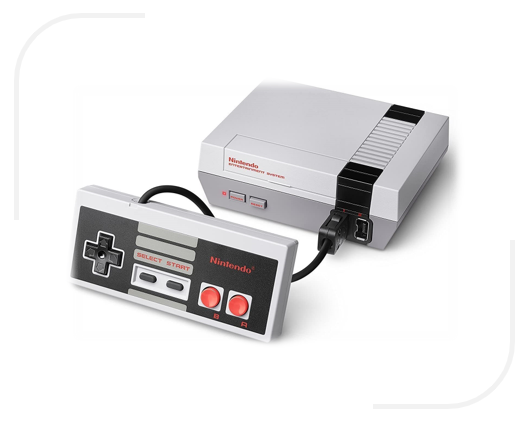
Nintendo | Mini NES
“Nintendo | Classic Nintendo Entertainment System (NES)”
Manufacturer.| Nintendo
Type. | Home Video Game Console
Generation.| Third (3rd)
Controllers


The game controller for both the NES and the Famicom has an oblong brick-like design with a simple four button layout: two round buttons labeled "A" and "B", a "START" button, and a "SELECT" button. Additionally, the controllers utilize the cross-shaped D-pad, designed by Nintendo employee Gunpei Yokoi for Nintendo Game & Watch systems, to replace the bulkier joysticks on controllers of earlier gaming consoles.
The original model Famicom features two game controllers, both of which are hardwired to the back of the console. The second controller lacks the START and SELECT button, featuring a small microphone instead; however, few games use this feature. The earliest produced Famicom units have square A and B buttons; issues with them getting stuck when pressed down led Nintendo to change their shape to a circular design in subsequent units following the console's recall.
Instead of the Famicom's hardwired controllers, the NES has two proprietary seven-pin ports on the front of the console to support detachable controllers and third-party peripherals. The controllers bundled with the NES are identical and include the START and SELECT buttons, lacking the microphone on the original Famicom's second controller. The cables for NES controllers are also generally three times longer than their Famicom counterparts.
A number of special controllers are intended for use with specific games, though are not commonly utilized. Such peripherals include the NES Zapper (a light gun), R.O.B. (a toy robot), and the Power Pad (a dance pad). The original Famicom has a deepened DA-15 expansion port on the front of the unit to accommodate them.
Two official advanced controllers were produced for the NES: the NES Advantage, an arcade controller produced by Asciiware and licensed by Nintendo of America; and the NES Max, a controller with grip handles that featured a "cycloid" sliding-disc D-pad in place of the traditional one. Both controllers have a "Turbo" feature, which simulates multiple rapid button presses, for the A and B buttons; the NES Max has manually pressed Turbo buttons, while the NES Advantage offers toggle buttons for Turbo functionality along with knobs that adjust the firing rate of each button. The latter also includes a "Slow" button that rapidly pauses games, though this function is not intended for games that invoke a pause menu or screen.
The standard game controller was redesigned upon the introduction of the redesigned console. Though the original button layout was retained, the shape of the redesigned controller—nicknamed the "dog bone" controller—resembles that of the Super Famicom/NES. In addition, the redesigned Famicom adopted NES-style detachable controller ports.
The original NES controller has become one of the most recognizable symbols of the console. Nintendo has mimicked the look of the controller in several other products, from promotional merchandise to limited edition versions of the Game Boy Advance.
Games Paks

The NES uses a 72-pin design, as compared with 60 pins on the Famicom. To reduce costs and inventory, some early games released in North America are simply Famicom cartridges attached to an adapter to fit inside the NES hardware. Early NES cartridges are held together with five small slotted screws. Games released after 1987 were redesigned slightly to incorporate two plastic clips molded into the plastic itself, removing the need for the top two screws.
The back of the cartridge bears a label with handling instructions. Production and software revision codes were imprinted as stamps on the back label to correspond with the software version and producer. All licensed NTSC and PAL cartridges are a standard shade of grey plastic, with the exception of The Legend of Zelda and Zelda II: The Adventure of Link , which were manufactured in gold-plastic carts. Unlicensed carts were produced in black, robin egg blue, and gold, and are all slightly different shapes than standard NES cartridges. Nintendo also produced yellow-plastic carts for internal use at Nintendo Service Centres, although these "test carts" were never made available for purchase. All licensed US cartridges were made by Nintendo, Konami, and Acclaim. For promotion of DuckTales: Remastered , Capcom sent 150 limited-edition gold NES cartridges with the original game, featuring the Remastered art as the sticker, to different gaming news agencies. The instruction label on the back includes the opening lyric from the show's theme song, "Life is like a hurricane".
Famicom cartridges are shaped slightly differently. Unlike NES games, official Famicom cartridges were produced in many colours of plastic. Adapters, similar in design to the popular accessory Game Genie, are available that allow Famicom games to be played on an NES. In Japan, several companies manufactured the cartridges for the Famicom. This allowed these companies to develop customized chips designed for specific purposes, such as superior sound and graphics.
Game rentals
As the Nintendo Entertainment System grew in popularity and entered millions of American homes, some small video rental shops began buying their own copies of NES games, and renting them out to customers for around the same price as a video cassette rental for a few days. Nintendo received no profit from the practice beyond the initial cost of their game, and unlike movie rentals, a newly released game could hit store shelves and be available for rent on the same day. Nintendo took steps to stop game rentals, but did not take any formal legal action until Blockbuster Video began to make game rentals a large-scale service. Nintendo claimed that allowing customers to rent games would significantly hurt sales and drive up the cost of games. Nintendo lost the lawsuit, but did win on a claim of copyright infringement. Blockbuster was banned from including photocopies of original, copyrighted instruction booklets with its rented games. In compliance with the ruling, Blockbuster produced original short instructions—usually in the form of a small booklet, card, or label stuck on the back of the rental box—that explained the game's basic premise and controls. Video rental shops continued the practice of renting video games.
Legacy
The NES was released two years after the video game crash of 1983, when many retailers and adult consumers regarded electronic games as a passing fad, so many believed at first that the NES would soon fade. Before the NES and Famicom, Nintendo was known as a moderately successful Japanese toy and playing card manufacturer, but the consoles' popularity helped the company grow into an internationally recognized name almost synonymous with video games as Atari had been, and set the stage for Japanese dominance of the video game industry. With the NES, Nintendo also changed the relationship between console manufacturers and third-party software developers by restricting developers from publishing and distributing software without licensed approval. This led to higher-quality games, which helped change the attitude of a public that had grown weary from poorly produced games for earlier systems.
The NES hardware design is also very influential. Nintendo chose the name "Nintendo Entertainment System" for the US market and redesigned the system so it would not give the appearance of a child's toy. The front-loading cartridge input allowed it to be used more easily in a TV stand with other entertainment devices, such as a videocassette recorder.
The system's hardware limitations led to design principles that still influence the development of modern video games. Many prominent game franchises originated on the NES, including Nintendo's own Super Mario Bros. , The Legend of Zelda and Metroid , Capcom's Mega Man franchise, Konami's Castlevania franchise, Square's Final Fantasy , and Enix's Dragon Quest franchises.
NES imagery, especially its controller, has become a popular motif for a variety of products, including Nintendo's Game Boy Advance. Clothing, accessories, and food items adorned with NES-themed imagery are still produced and sold in stores.
Emulation
The NES can be emulated on many other systems. The first emulator was the Japanese-only Pasofami. It was soon followed by iNES, which is available in English and is cross-platform, in 1996. It was described as being the first NES emulation software that could be used by a non-expert. The first version of NESticle, an unofficial MS-DOS-based emulator, was released on April 3, 1997. Nintendo offers licensed emulation of some NES games via its Virtual Console service for the Wii, Nintendo 3DS, and Wii U, and via its Nintendo Switch Online service.
Re-release
On July 14, 2016, Nintendo announced the November 2016 launch of a miniature replica of the NES, named the Nintendo Entertainment System: NES Classic Edition in the United States and Nintendo Classic Mini: Nintendo Entertainment System in Europe and Australia. The emulation-based console includes 30 permanently bundled games from the vintage NES library, including the Super Mario Bros. series and The Legend of Zelda series. The system has HDMI display output and a new replica controller, which can also connect to the Wii Remote for use with Virtual Console games. It was discontinued in North America on April 13, 2017, and worldwide on April 15, 2017. However, Nintendo announced in September 2017 that the NES Classic Mini would return to production on June 29, 2018, only to be discontinued again permanently by December of that year.
Released Date.| 2016 Worldwide
Discontinued.| n/a
Worldwide Units Sold.| n/a